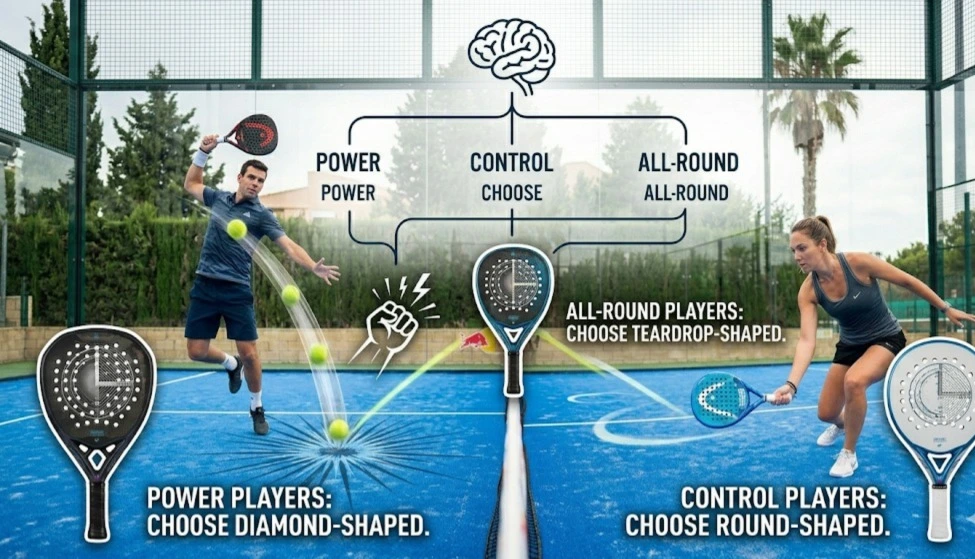
If comfort and control are your primary goals, the round-shaped padel racket is the single most logical starting point regardless of your experience level. Round frames position the sweet spot in the centre of the face, exactly where the majority of shots make contact, and carry a low or mid balance point that keeps the weight close to the handle.
This low balance creates a racket that feels light and quick in the hand, easy to manoeuvre at the net, and far less fatiguing over a full match than a head-heavy alternative. For women who are new to padel, returning from injury, or managing any existing wrist or elbow sensitivity, a round frame is the clear recommendation — and it is the shape used by a significant proportion of WPT Women’s circuit players including Carolina Navarro and Alejandra Salazar throughout their careers.
What a Round Frame Delivers
- Maximum sweet spot size:The largest forgiving zone on the face shots hit anywhere near the centre travel with good direction and feel, not just perfectly struck balls.
- Low balance = wrist-friendly swing:The weight sits toward the handle, reducing rotational stress on the wrist and elbow on every shot and particularly on off-centre contact.
- Fast net reactions:A low-balance round frame moves quickly through the air ideal for reactive volleys and defensive blocks at the net where split-second timing matters.
- Best injury prevention profile:Round frames with soft cores produce the least vibration transmission of any padel racket type. For any player with a history of lateral epicondylitis (padel elbow) or wrist strain, this shape is the safest choice.
 Level Guidance: Round frames are not only for beginners. Many advanced women players choose round frames specifically for their control advantage in long matches. The sweet spot never lies and in a tight third set, a forgiving frame wins more points than a punishing one.
The shape of the frame determines where your sweet spot sits. The core material determines how the racket feels when the ball hits it — and for women prioritising comfort, this is arguably the more important variable of the two. A round frame with a hard EVA core will still transmit significant vibration on off-centre shots. A round frame with a soft or multi-layer foam core absorbs that vibration before it reaches your hand.
The padel industry’s shift toward multi-layer hybrid core construction , one of the most significant equipment developments of 2025 and 2026 has made this distinction more meaningful than ever. Brands including Nox, Bullpadel, Head, and Wilson have all introduced frames with layered core profiles that blend a firmer outer foam layer for power transfer with a softer inner layer specifically engineered for vibration dampening. The result is a racket that feels smooth and comfortable on every shot, including off-centre ones.
Core Types and What They Mean for Comfort
- Soft EVA foam (single layer):Good vibration dampening, decent control. The traditional choice for comfort-focused players. Found across most round and teardrop frames at beginner and intermediate level.
- Multi-layer hybrid foam (2025–2026 standard):Best-in-class vibration absorption combined with improved dwell time the ball stays on the strings fractionally longer, giving your hand more time to guide the direction. The most significant comfort upgrade available in 2026.
- Hard EVA foam:Produces more power but significantly more vibration. Not recommended for women with any wrist, elbow, or shoulder sensitivity. Best avoided unless your physical conditioning specifically supports it.
- Rubber foam (older formulation):Very soft, very comfortable, but reduces power significantly. Still found in entry-level frames fine for casual play but limiting for players developing their game.
 2026 Material Update: The rough surface texture trend increasingly standard across premium and mid-range frames in 2026 adds another comfort benefit: the textured face generates natural spin on every shot, which means you need less arm swing to create ball movement. Less swing effort over a match means less cumulative arm fatigue.
Once a player is consistently hitting the sweet spot on a round frame typically after 12 to 18 months of regular play the teardrop or hybrid shape is the natural and logical next step. It offers a larger sweet spot and more forgiving feel than a diamond, while generating meaningfully more power than a round frame because of its slightly higher balance point and elongated head.
The teardrop is the shape that most women’s padel coaching programmes now recommend as the transition racket the frame that bridges beginner comfort and advanced performance without forcing a stark trade-off between the two. It is also the shape most widely used among intermediate and club-competitive women players who want genuine tactical flexibility: control at the net, enough pace from the baseline to put opponents under pressure.
Who the Teardrop Suits Best
- Players who have been playing consistently for 12+ months:You have reliable footwork and contact point — the slightly smaller sweet spot of a teardrop will not punish you under normal rally conditions.
- Players who want to develop baseline drives:The teardrop’s mid-to-high balance gives you more momentum through the shot, adding pace to groundstrokes without requiring more physical effort.
- Players in competitive doubles:The tactical versatility of a teardrop — control at the net, power from the baseline — suits the multi-role demands of doubles play better than a specialist round or diamond frame.
- Players transitioning from another racket sport:Tennis players moving into padel often find the teardrop feels most familiar — the balance and feel echo the control-power balance of a tennis racket more closely than a round padel frame.
 Transition Tip: Do not abandon your round frame the day you buy a teardrop. Use the teardrop in practice sessions for 4 to 6 weeks before switching it to your match frame. The transition is smoother and you will not regress in match performance during the adaptation period.
String tension is the most overlooked comfort variable in padel, and it is one of the most immediately impactful changes you can make without buying a new racket. Yet the majority of women who buy a padel racket never adjust the factory string tension they simply play on whatever the manufacturer set, which is often not optimised for their physical profile or priorities.
Lower string tension typically 20 to 23 kg for comfort-focused women’s play creates a larger trampoline effect on impact. The strings flex more, keeping the ball on the string bed fractionally longer, which gives your hand more time to guide direction and absorbs more of the impact shock before it reaches your wrist. This is the same principle as choosing a softer core more contact time, more comfort, more control.
Recommended String Tension by Priority
- Maximum comfort and arm protection (20–22 kg):Best for players with any existing elbow, wrist, or shoulder sensitivity. Produces a soft, cushioned feel on every contact and the widest effective sweet spot.
- Comfort and control balance (22–24 kg):The most recommended range for club-level women players. Enough trampoline effect for comfort and dwell time, with sufficient tension for directional precision.
- Control and feel (24–26 kg):For experienced players who want crisp feedback and precise directional control and have no arm sensitivity concerns.
- String type update (2026):Multifilament padel strings now widely available from Head, Babolat, Camewin and Wilson offer significantly better vibration dampening than monofilament alternatives at equivalent tension. A multifilament string at 22 kg delivers meaningfully more comfort than a monofilament at the same tension.
 Practical Action: If you have never had your padel racket restrung, or if it has been more than three to four months since your last restring, book a restring at lower tension before your next session. The difference in comfort and feel on the first shot will be immediately noticeable and it costs far less than a new racket.