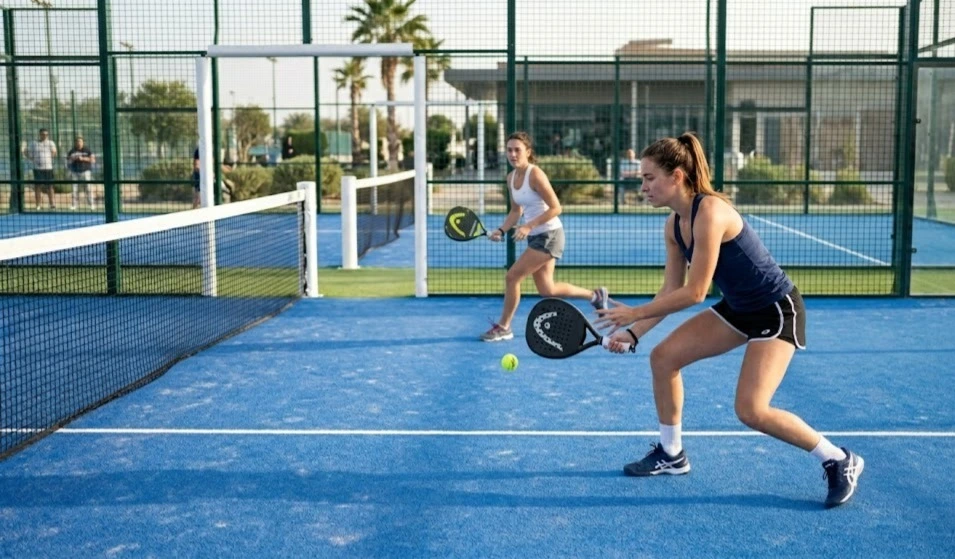
Net play is where padel matches are won and for most beginners, it is also where confidence goes to die. Padel volleys feel nothing like groundstrokes. The pace is faster, the time to react is shorter, the margin for error is smaller, and the technique required is fundamentally different from anything a beginner has built at the baseline. Most beginners do not struggle with volleys because they lack athleticism or coordination. They struggle because nobody has clearly explained what the volley actually is, how it works mechanically, and why the instincts developed at the baseline actively work against you at the net.
These six reasons account for the vast majority of beginner volley problems at club level in 2026. Each one is correctable within weeks — not months when the underlying cause is properly understood and specifically addressed.
2026 Coaching Insight: Analysis across beginner programmes at padel academies in the UK, Spain, and UAE consistently identifies net play as the skill area where new players plateau longest not because it is the hardest skill, but because it is the most incorrectly taught. Most beginners are shown what to do at the net without being told why their natural instincts work against them there.
The volley is not a mini groundstroke. It is a completely different shot with different mechanics, different timing, and a different mental approach. Until beginners understand this, they will keep swinging at the net and keep losing the point.
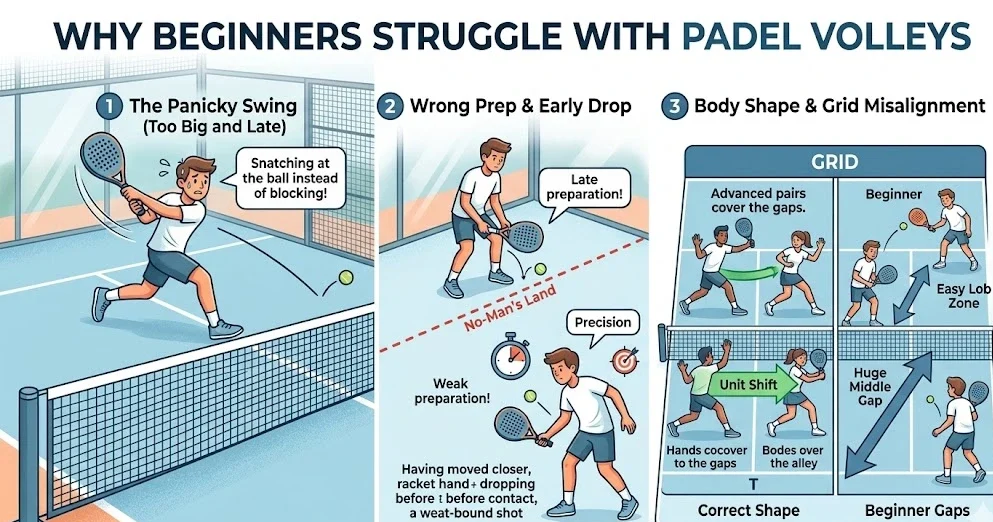
Beginner Volley Struggles — Diagnosis and Fix at a Glance

REASON 1: Treating the Volley Like a Groundstroke
This is the foundational mistake from which almost every other beginner volley error flows. When a beginner sees a ball coming at the net, their baseline instincts take over: they draw the racket back, load the swing, and drive through the ball. At the baseline, this produces a reasonable groundstroke. At the net, it produces a frame error, a ball into the side glass, or a shot that arrives a full second too late because the swing was too long for the available time.
The volley is not a swing — it is a block and redirect. The ball arrives with pace already on it. Your job is to redirect that pace, not generate more of it. The correct volley mechanics use a compact punch with the elbow leading forward, no backswing beyond the shoulder, and a stiff wrist at contact that holds the angle through the ball rather than flicking through it.
- No backswing: The racket head should never go past your shoulder on a volley preparation. If it does, you have already started a groundstroke and the volley will be late.
- Elbow leads: Drive the elbow forward toward the ball, then let the racket head follow. This keeps the swing compact and the timing predictable.
- Stiff wrist at contact: Unlike groundstrokes, the wrist does not snap through on a volley. It holds firm, maintaining the racket face angle through contact.
🎯 Drill: Stand one metre from a wall and volley the ball into it repeatedly using only a punch no backswing at all. If the ball keeps going into the wall cleanly, your volley mechanics are correct. This drill builds the compact punch faster than any other exercise.
REASON 2: Standing Flat-Footed
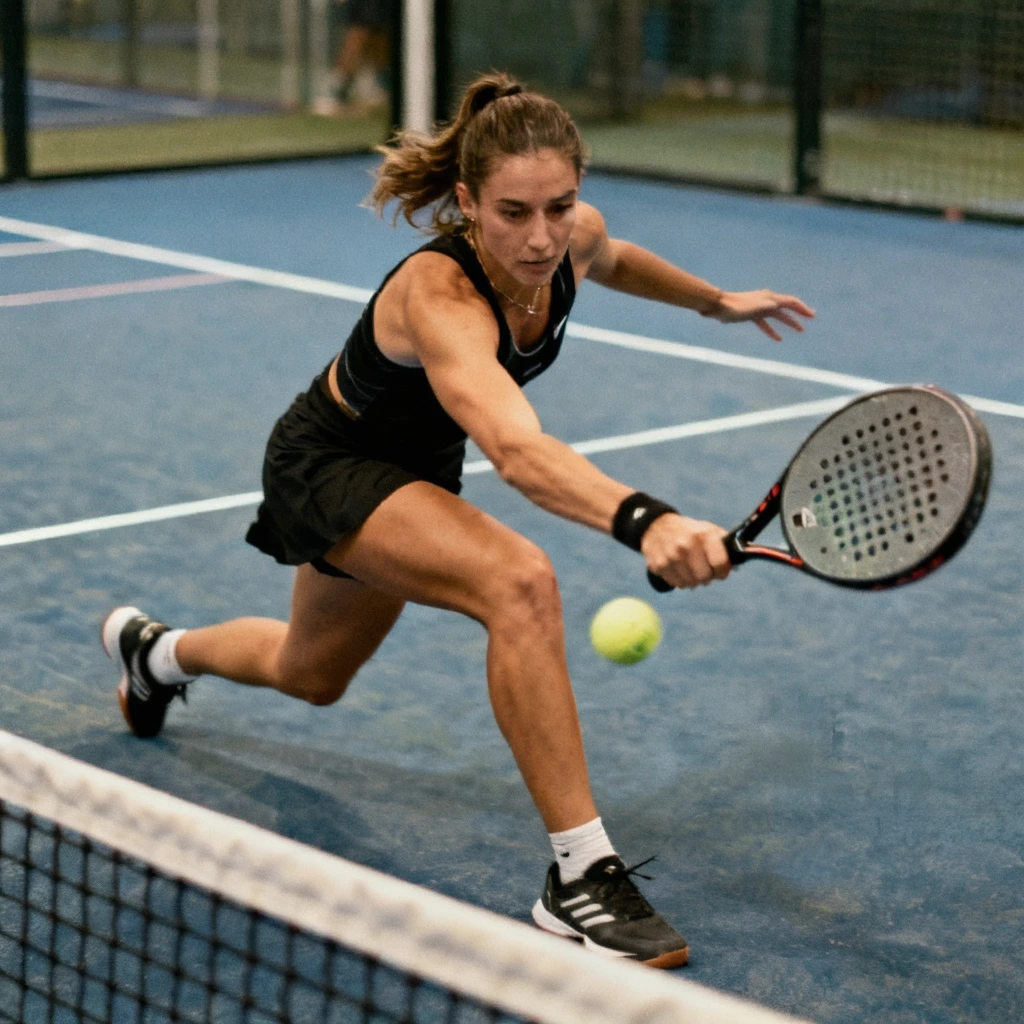
Most beginner net players stand completely still between shots, waiting for the ball to arrive before starting to move. By the time the brain has registered where the ball is going and sent the signal to move, the ball has already passed. This is not a reaction speed problem it is a pre-loading problem, and it is solved entirely by the split step.
The split step is the single most important net skill in padel more important than any volley technique. Landing your split step at the exact moment your opponent makes contact pre-loads your legs for an explosive first step in any direction, reducing your reactive movement initiation from 0.4 seconds to under 0.2 seconds. That 0.2-second difference is the gap between reaching a wide volley and watching it pass.
- Split step timing: Both feet leave the ground and land simultaneously the instant your opponent’s racket contacts the ball not before, not after.
- Landing position: Feet slightly wider than shoulders, knees bent, weight on balls of feet not heels. This pre-loaded position allows immediate explosive movement.
- Consistency:The split step is not optional. It must happen on every single shot your opponent plays at the net, without exception. Making it automatic is the single fastest way to improve net play.
⚡ Practice Method: In your next net session, focus only on the split step for 10 minutes ignore where the volley goes. Just land the split step on every ball. Players who do this consistently for three weeks report dramatically improved net coverage without any change to their volley technique.
REASON 3: Racket Too Low Between Shots
Watch any beginner at the net and you will almost always see the same thing: the racket drops to waist height or lower between volleys. This forces the player to lift the racket back to contact height on every ball adding 0.3 to 0.5 seconds of unnecessary preparation time that the pace of net play does not allow.
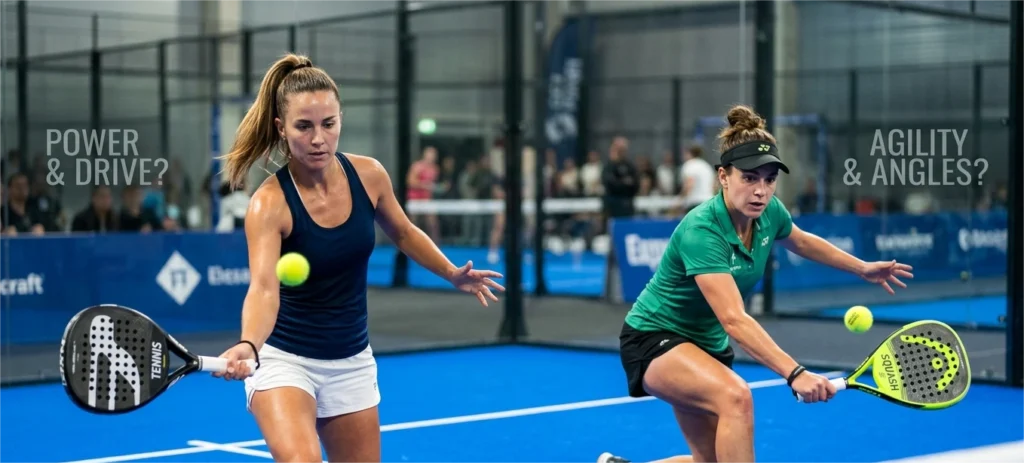
The default racket position at the net should be head height racket face level with or above your own shoulder, pointing slightly toward the opponent. From this position, you can reach low balls by dropping the racket head down while keeping the elbow high, and you can handle high balls without any additional lift. The compact range of motion from a high default position is what makes net play feel fast and in control rather than reactive and desperate.
- Ready position: Racket face at chest-to-shoulder height between every volley. This is your reset position after every shot not waist, not dropped.
- Non-dominant arm:Keep it slightly extended forward for balance. It acts as a natural guide for the racket face and stops the racket drifting too far to one side.
- Racket in front of body:The racket head should always be visible in your peripheral vision at the net. If you cannot see it, it has drifted behind your body and you have lost the ready position.
💡 Visual Cue: Imagine holding a tray of drinks at chest height between volleys. That is the correct racket height and the correct forearm position. You would not let the tray drop to your waist between steps do not let your racket drop to your waist between volleys.
REASON 4: Positioning Too Far Back from the Net
Beginners instinctively back away from the net particularly when opponents have a high ball or are winding up for an aggressive shot. This safety-seeking behaviour is understandable but tactically counter-productive. Standing 3 to 4 metres from the net eliminates the angle advantage of net position, gives opponents more time for their return to clear you, and forces you to play the ball below net height rather than intercepting it at a manageable height. The best position at the net in padel is 1 to 2 metres behind the net tape close enough to cut off angles and intercept balls before they drop.
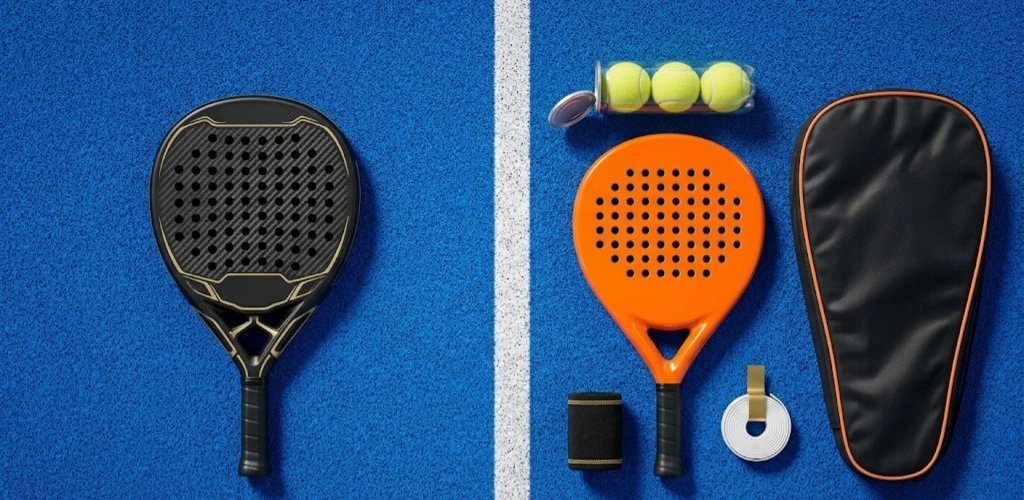
This is one of the areas where equipment makes a genuine difference. A beginner padel racket with a large sweet spot and low balance point gives new net players more forgiveness when they advance to a closer net position and are still developing consistent contact. The lighter swing weight means faster wrist reactions on balls that arrive quickly at close range which is exactly the scenario that an advanced net position creates.
- Target net distance:Stand 1 to 1.5 metres behind the net tape as your default forward position during a rally. Move closer only when playing a put-away volley.
- When to step back:Only when a lob is clearly going over your head. Step back to the T-line, not to the baseline. Standing at the baseline during a net battle is a surrender of every positional advantage.
- Court coverage from close net position:At 1 to 1.5 metres from the net, you cover approximately 70% of the court width with a single crossover step. At 3 metres, that coverage drops to under 50%.
 Net Position Drill: Place two cones 1.5 metres behind the net one on each side of the centre line. These are your target positions during doubles net play. Any time you find yourself behind the cones during a rally, consciously step forward before the next ball arrives.
REASON 5: No Shot Selection at the Net
Most beginner net players hit every volley in the most natural direction usually cross-court from their forehand side, or straight ahead from wherever the ball comes from. Opponents read this pattern within two or three rallies and start positioning for the obvious zone before you even make contact. The result: volleys that should win points become easily anticipated and returned.
Effective net play requires at minimum two directional options from every position cross-court and down the line and the ability to disguise which you are choosing until the last possible moment. This does not require advanced technique. It requires conscious shot selection before the ball arrives and a basic understanding of body angle deception.
- Two-option rule: Before every volley, identify both available directions. Commit to one but keep your body position neutral long enough to leave both options credible to the opponent.
- Aim for the feet: The safest and most effective beginner volley target is the opponent’s feet not the open court. A ball aimed at an opponent’s feet forces an upward return from a cramped position and is harder to mis-hit than a sharp angle.
- Change direction deliberately: If you have hit cross-court twice in a row, the opponent is expecting the third cross-court. That is the moment the down-the-line volley produces the highest error rate.
🧠 Tactical Rule: Aim at the opponent’s feet three times in a row before attempting an open-court angle. Feet targets win more net points at beginner level than angle attempts because they are higher percentage and they set up the angle when you do eventually go for it.
REASON 6: Wrong Racket Making Net Play Harder Than It Needs to Be
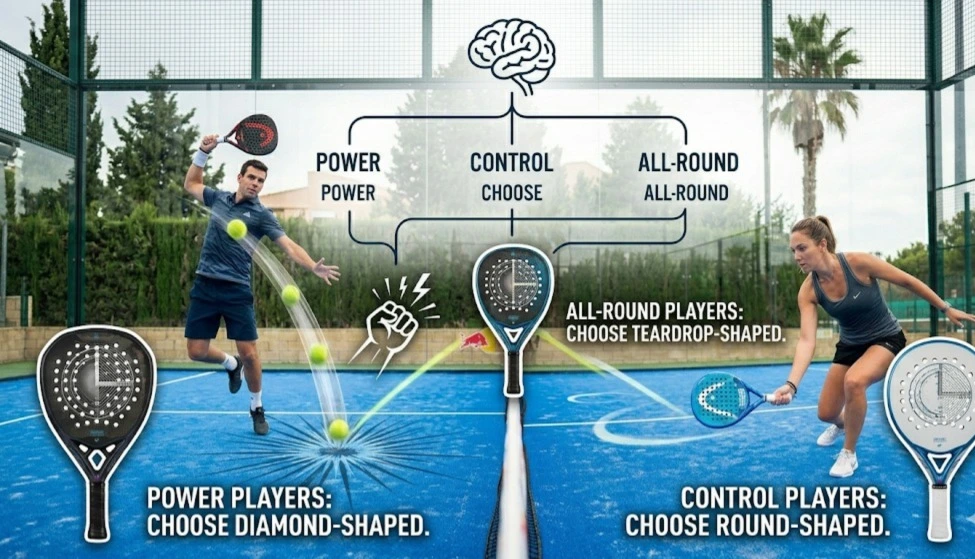
Equipment plays a more significant role in beginner net play than most players acknowledge. A heavy, head-heavy frame the type that suits an aggressive baseline smasher is the worst possible tool for learning net play. The additional head weight slows wrist reaction speed, makes the racket harder to redirect quickly on close-range balls, and increases arm fatigue during the rapid sequential volley exchanges that characterise close net battles.
Beginners learning net play on a round or low-balance teardrop frame from the beginner padel racket consistently develop volley mechanics faster than those on heavier, head-heavy alternatives. The lighter swing weight allows the wrist to guide direction naturally without fighting the frame’s momentum. As technique develops and net play becomes more instinctive, a transition to a mid-balance intermediate padel racket preserves that net agility while adding the groundstroke power that a more complete game requires. The most advanced net players those using advanced padel rackets with carbon precision and specialist balance points have typically built their net game on softer, more forgiving frames first.
- Ideal net play frame weight:345 to 365 grams. Light enough for rapid wrist movement, heavy enough for stable volley contact.
- Balance point: Low to mid. Head-heavy balance slows the wrist on quick net exchanges the opposite of what developing net players need.
- Sweet spot size: Larger is better for beginners at the net. The fast pace of close-net volleys means contact is frequently off-centre a forgiving sweet spot covers these errors while technique is still developing.
🔧 Equipment Check: Hold your racket loosely at the throat and let it balance. If it tips immediately toward the head, it is head-heavy. For net-focused beginners, a frame that barely moves or tips gently toward the handle is a significantly better learning tool.
Net Play Is a Skill — Build It in the Right Order
Every beginner struggles with padel volleys and net play. It is not a sign of poor coordination or slow reactions it is a predictable consequence of learning a skill where the correct technique is the opposite of instinct. Swinging is natural. Punching is learned. Backing away is natural. Holding the close position is learned. Standing still between shots is natural. The split step is learned.
The players who break through their beginner net play ceiling fastest are the ones who understand why their instincts are wrong at the net and deliberately override them with the correct mechanics. Start with the split step. Add the compact punch. Build the rest from there. And make sure the padel racket in your hand gives your developing net game the best possible foundation because fighting the wrong equipment while learning new mechanics is the slowest possible path to improvement.
Net play feels uncomfortable at first for every beginner. That discomfort is not failure it is the gap between what your instincts tell you and what the technique requires. Close that gap deliberately, and the net becomes your strongest position on court.